For Argentina fans, the road to the 2026 FIFA World Cup is more than a countdown to kickoff. It is the continuation of a golden competitive cycle built on unity, clarity, and big-game calm. After lifting the 2022 World Cup and then reinforcing that status with major international silverware, La Albiceleste arrive in the 2026 era with something every contender craves: a proven identity and a winning habit.
This article breaks down Argentina’s 2026 World Cup outlook in a factual, fan-friendly way: what the team has achieved most recently, the core strengths that travel well in tournament football, the players and roles that define the side, and why the Albiceleste remain one of the most compelling teams on the planet.
Why Argentina’s 2026 World Cup Story Starts With Confidence
Confidence in international football is not hype; it is a competitive advantage. Argentina’s recent success provides tangible benefits that show up in tight matches: better emotional control, clearer decision-making under pressure, and belief that the next chance will come even if a game gets messy.
Since 2021, Argentina have stacked elite trophies in a way that signals consistency, not a one-off peak. That matters in a World Cup, where the difference between quarterfinal heartbreak and a deep run can come down to a single moment of composure.
Most recent Copa América titles (and why they matter)
- Copa América 2021: Ended a long wait for a senior men’s trophy and validated a new team culture built on togetherness.
- Copa América 2024: Confirmed that Argentina’s standards and structure remained strong across tournament cycles, not just one magical run.
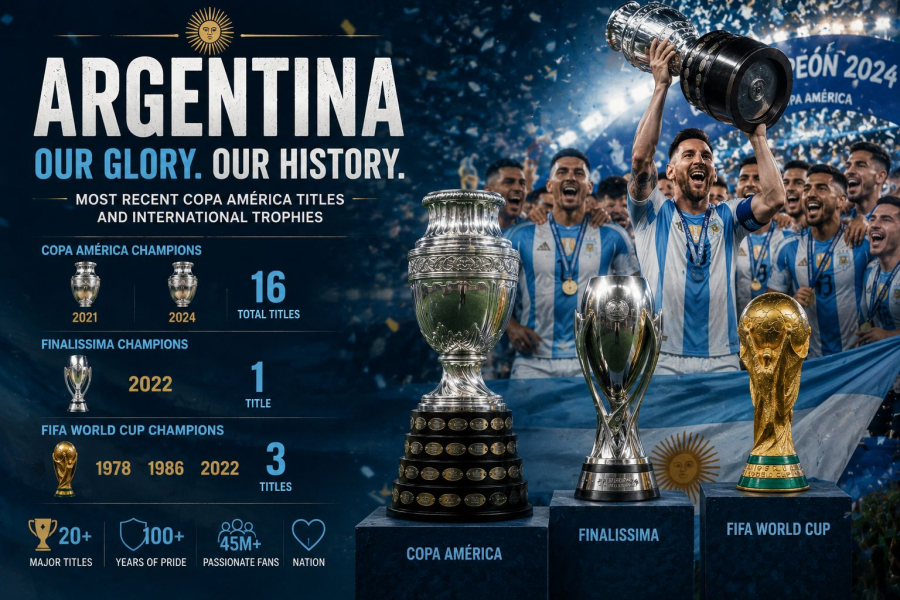
Winning Copa América is never “just” a regional achievement. It is a high-pressure tournament against familiar rivals with intense environments, varied styles, and limited room for error. Those are the same conditions that define a World Cup.
Argentina’s Recent International Trophies: A Snapshot
If you’re an Argentina supporter, you’ve seen something special: a team that can win in multiple ways. Sometimes it’s controlled possession. Sometimes it’s defensive resilience and surgical counterattacks. Sometimes it’s pure nerve in the biggest moments.
Here is a clear overview of Argentina’s major senior men’s international trophies, including the most recent titles that shape expectations for 2026.
| Trophy | Titles (Argentina) | Most recent win | Notes |
|---|---|---|---|
| FIFA World Cup | 3 | 2022 | Also won in 1978 and 1986 |
| Copa América | 15 | 2024 | Also won in 2021; historically one of the top nations in the competition |
| CONMEBOL–UEFA Cup of Champions (Finalissima) | 2 | 2022 | Also won in 1993 (then known as the Artemio Franchi Cup) |
These wins help explain why Argentina enter the 2026 conversation with credibility. They have beaten elite opponents on major stages, and they have done it with a group that has matured together.
What Makes Argentina a 2026 World Cup Threat?
World Cups reward teams that can solve different problems across seven matches: deep blocks, high presses, transitions, extra time, and penalty shootouts. Argentina’s recent cycle has shown strengths that translate well to a tournament setting.
1) A clear tactical identity under Lionel Scaloni
Under head coach Lionel Scaloni, Argentina have been recognized for tactical flexibility without losing their core principles. The team can shift shapes and roles depending on the opponent, but the fundamentals remain stable:
- Compactness without fear: Argentina can defend with discipline while still carrying threat on the break.
- Midfield balance: The side often blends ball-winning, tempo control, and forward-running in the same unit.
- Collective responsibility: Forwards press and track, midfielders cover, defenders step in with confidence.
In tournament football, identity is oxygen. When legs are heavy and pressure spikes, teams revert to habits. Argentina’s habits are built for the biggest stages.
2) A squad built for both control and chaos
The best international sides can win “clean” games and survive “ugly” ones. Argentina’s recent success has showcased both abilities:
- Control: Patient circulation, smart positioning, and the ability to slow a match down when needed.
- Acceleration: Quick vertical attacks, decisive runners, and confidence in one-v-one moments.
- Game management: Knowing when to press, when to rest with the ball, and how to protect a lead.
That blend is valuable in 2026, where the expanded tournament format increases the importance of squad depth and adaptability across different opponents.
3) Winning experience in pressure moments
Recent titles have given many Argentina players firsthand knowledge of what it feels like when the margins disappear. That experience shows up in the details: a defender choosing the right moment to step, a midfielder drawing a foul at the perfect time, a forward making the selfless run that opens the lane.
In a World Cup, talent opens the door, but mentality walks you through it.
Key Players and Roles Fans Will Watch Toward 2026
It is impossible to preview Argentina without acknowledging the names that have defined this era. At the same time, part of the excitement for 2026 is how the team’s core continues to evolve, with experienced champions and newer leaders sharing responsibility.
Lionel Messi: the heartbeat of an era
Lionel Messi remains the most influential figure of this Argentina generation. Beyond goals and assists, his presence affects opponents’ defensive planning and gives teammates belief in decisive moments. For 2026, the key storyline is not a promise of what will happen, but the undeniable truth that Argentina’s environment has been built to maximize calm, clarity, and collective support around its stars.
Julián Álvarez: movement, pressure, and big-game bite
Julián Álvarez represents the modern tournament forward: relentless in pressing, sharp in transitions, and comfortable making the kinds of runs that create chances even when he doesn’t touch the ball. In a World Cup, that profile is priceless because it raises the team’s floor in difficult matches.
Emiliano Martínez: elite goalkeeping and edge
Emiliano Martínez has become synonymous with big saves and big moments. Great goalkeeping is often the silent difference between a close win and a painful exit, especially in knockout rounds where one shot can decide everything.
Midfield engine: balance, intelligence, and control
Argentina’s midfield has been a foundation of recent trophies, offering a mix of technical quality, defensive coverage, and tactical understanding. Players such as Rodrigo De Paul, Enzo Fernández, and Alexis Mac Allister have helped Argentina play with structure without losing spontaneity.
Defensive platform: competitive, organized, and confident
Championship teams defend as a unit, and Argentina’s structure has consistently allowed them to compete against elite attacks. Center-backs like Cristian Romero (and a wider defensive group around him) embody the intensity and front-foot defending that helps Argentina sustain pressure and recover the ball in useful areas.
How Recent Copa América Success Supports a 2026 World Cup Run
Copa América is often a brutal test: short recovery times, emotional rivalries, and opponents who know you well. When Argentina win it, they do more than collect a trophy. They reinforce habits that help in a World Cup.
Benefits Argentina gain from Copa América winning cycles
- High-pressure reps: Knockout football teaches discipline and emotional control.
- Squad trust: Tournament minutes spread responsibility beyond just the headline names.
- Winning standards: Training intensity, preparation, and focus become non-negotiable.
- Tactical adaptability: Facing varied styles forces solutions that later matter in a World Cup group stage.
Argentina’s recent Copa América titles in 2021 and 2024 therefore function as more than historic moments. They are practical preparation for the specific demands of 2026.
Argentina and the 2026 World Cup: What the Tournament Context Means
The 2026 FIFA World Cup will be staged across the United States, Canada, and Mexico. For fans and teams alike, the setting matters because it shapes travel rhythms, recovery routines, and match preparation.
From a football perspective, an expanded World Cup format increases the need for:
- Squad depth: More matches can mean more rotation and more roles for the bench.
- Professional game management: Navigating group stages efficiently helps conserve energy.
- Mental durability: Tournament length and attention can be draining; experienced winners often handle it best.
Argentina’s recent trophy run suggests they are well suited to these demands because they have already proven they can manage tension, expectations, and the fine margins that define title contenders.
The Argentina Fan Perspective: Why Belief Feels Different Now
Every generation of Argentina supporters has emotion stitched into their relationship with the national team. What makes the current era stand out is that the team’s success feels sustainable because it is supported by structure and unity, not only individual brilliance.
For fans looking toward 2026, there are real, positive reasons to believe:
- A champion’s culture: Players understand what it takes daily, not just on matchday.
- Leaders across the pitch: From goalkeeper to midfield to attack, leadership is shared.
- A tactical staff with credibility: Scaloni’s group has shown preparation and adaptability on the biggest stages.
- A nation that travels emotionally: Argentina support can turn neutral venues into high-energy stages.
That combination creates a powerful feedback loop: confidence fuels performance, performance fuels belief, and belief raises the team’s resilience when games get tight.
Argentina’s International Trophy Legacy (and How It Inspires 2026)
Argentina do not enter World Cups hoping to participate. They enter to compete for the trophy, because their history proves it is possible. The legacy includes:
- FIFA World Cup titles: 1978, 1986, 2022
- Copa América titles: A record total of 15, including the most recent in 2021 and 2024
- Finalissima titles: 1993 and 2022
For a fan base, legacy can be a burden or a boost. Right now, for Argentina, it looks like a boost: a reminder that the shirt is heavy, yes, but it is also powerful.
What “Success” Could Look Like for Argentina in 2026
In football, no serious preview should promise outcomes. A World Cup is too unpredictable, and every contender faces top-level opponents who can punish any dip in focus.
What can be stated confidently is this: Argentina have the elements of a successful tournament team. If they bring their recent standards into 2026, success can include:
- Strong group-stage control: Efficient results that build rhythm.
- Knockout readiness: Tactical flexibility and emotional composure across different match scripts.
- Moments of quality: The ability to decide tight matches with one pass, one run, one save, or one set piece.
And for fans, there is a special kind of success too: watching a team that reflects Argentina’s footballing soul, fighting for every ball with intelligence and pride.
Final Take: Why Argentina Remain a 2026 World Cup Team to Fear
Argentina’s 2026 World Cup outlook is powered by recent proof. The Copa América titles in 2021 and 2024, the Finalissima 2022, and the unforgettable World Cup 2022 form a foundation that few nations can match in the current era.
For a big Argentina fan, the best part is that this team has delivered not only trophies, but a feeling: that La Albiceleste have found a modern identity rooted in collective strength. As the countdown to 2026 continues, Argentina will not just arrive with talent. They will arrive with belief, structure, and a winning standard that makes every opponent pay attention.
