The 2026 global men’s football tournament is shaping up to be one of the most watched sporting events in history, and if you love Argentina, the build-up is especially thrilling. With an expanded field, more matches, and a host region built for big crowds and big atmospheres, 2026 offers more chances to see elite football, more storylines to follow, and more opportunities for Argentina’s identity on the pitch to shine.
This guide breaks down what’s confirmed for 2026, how the new format works, what it means for fans, and why Argentina’s football culture is perfectly suited to a tournament that rewards consistency, depth, and momentum.
What’s different about the 2026 tournament (and why it’s a big deal)
2026 brings a major format upgrade designed to include more nations and deliver more matchdays for fans. That change isn’t just a statistic; it reshapes how teams manage squads, how supporters plan travel, and how the narrative of the tournament unfolds.
Key confirmed highlights
- Expanded field: 48 teams will participate.
- More matches: 104 total matches are scheduled, creating more high-stakes football across more days.
- Host region: Matches will be staged across Canada, Mexico, and the United States.
- Calendar window: The tournament is scheduled for June to July 2026.
From a fan perspective, this expansion increases variety: more styles of play, more “first-time” moments for nations, and more potential matchups that you’d rarely see outside a major tournament.
The 48-team format, explained in plain English
The 2026 edition uses a structure built to create a longer, more layered competition. While exact operational details can vary in presentation, the widely announced format is designed around a group phase that feeds into a large knockout bracket.
How the competition flows
- Group stage: 12 groups of 4 teams.
- Knockout stage: A round of 32 begins the single-elimination portion.
- The finish: Teams must win multiple knockout matches to lift the trophy, rewarding depth and consistency.
For supporters of a traditional powerhouse like Argentina, there’s a clear benefit: if your team is built to manage pressure, rotate intelligently, and maintain intensity, the expanded route can amplify those strengths over time.
Format snapshot table
| Stage | What it means | Why fans benefit |
|---|---|---|
| Group stage | Teams play multiple matches to qualify | More chances to watch your team and plan matchday experiences |
| Round of 32 | Knockout football starts earlier | More do-or-die games, more drama, more memorable nights |
| Later rounds | Quarterfinals, semifinals, final | Iconic matchups and the moments that define generations |
Why 2026 in North America is a win for fans
Hosting across three large, travel-ready countries creates a festival feel. For spectators, this kind of regional hosting can make the overall experience more flexible: more entry points, more flight options, and more potential cities to build a football-focused itinerary.
Fan-friendly advantages
- Stadium scale: Many venues in North America are built for huge crowds, which can translate into bigger sound and bigger spectacle on matchday.
- Travel infrastructure: Major international airports, extensive domestic flight networks, and a mature tourism industry can simplify logistics.
- Time zone variety: A wide spread of local kick-off times can help global audiences catch matches at reasonable hours.
For Argentina supporters in particular, North America often means strong diaspora communities and established football cultures in multiple cities, which can add energy beyond the stadium walls.
Argentina’s tournament identity: built for big stages
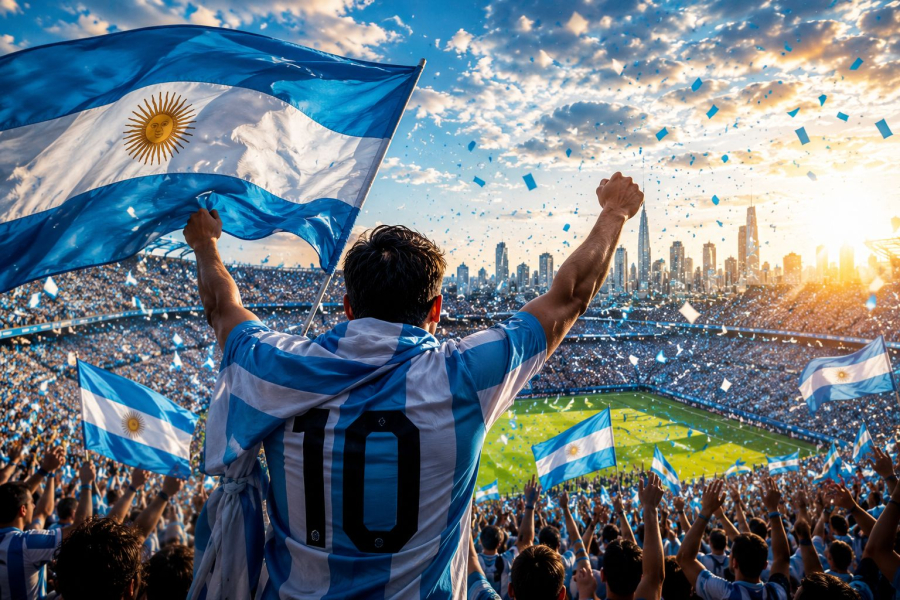
Argentina is one of football’s most decorated national teams, with a legacy shaped by technical quality, competitive edge, and a deep emotional connection between players and supporters. That identity tends to matter even more when matches become tighter and pressure rises.
A legacy that sets expectations (and fuels belief)
Argentina has won the top global men’s tournament three times (1978, 1986, 2022). Those titles weren’t built on luck. They were built on a recognizable footballing DNA: intelligent possession, decisive attacking play, and a mentality that can survive tense knockout moments.
In an expanded tournament with more matches, that mentality is a competitive asset. Over a longer schedule, teams that can stay composed, adapt tactically, and execute under stress tend to separate themselves.
What tends to travel well in international tournaments
- Game management: Knowing when to slow a match down, when to accelerate, and how to protect a lead.
- Technical security: Clean passing and control that holds up even under intense pressing.
- Set-piece discipline: Dead-ball moments often decide knockout ties.
- Squad cohesion: Teams that trust their structure can handle rotation and unpredictable scenarios.
Argentina’s strongest versions historically blend flair with pragmatism. That blend is ideal for a tournament where every round demands a different solution.
What Argentina fans can follow before 2026: the road to qualification
The journey to 2026 is part of the entertainment. Qualification campaigns create storylines, reveal tactical experiments, and show which players can deliver consistently against varied opponents and environments.
How to make the build-up more fun (and more meaningful)
- Track squad evolution: Watch how the team balances proven leaders with emerging talent.
- Pay attention to away performances: International tournaments demand comfort outside familiar settings.
- Notice pattern shifts: Pressing triggers, midfield rotations, and defensive spacing often change during qualification windows.
If you’re a dedicated supporter, the best part is seeing a “tournament-ready” identity take shape over time: a plan A that’s reliable, and a plan B that’s ready when a match turns complicated.
The expanded tournament: more matches, more moments, more momentum
With 104 matches scheduled, 2026 is built for fans who love the full experience: group-stage surprises, knockout tension, and those late-tournament nights where every pass feels heavier.
Why more matches is a benefit, not just a number
- More storylines: Breakout players, tactical trends, and unexpected contenders get space to develop.
- More high-stakes football: The knockout bracket is larger, meaning more “one bad moment changes everything” matches.
- More shared experiences: Watch parties, matchday rituals, and community gatherings have more chances to build momentum.
For Argentina supporters, momentum matters. When the team finds rhythm and belief, the fan base turns every match into an event, and that emotional energy becomes part of the tournament’s atmosphere.
How to plan a fan-first 2026 experience (even if you don’t travel)
You don’t need to be inside a stadium to feel the tournament. The key is planning a viewing experience that matches the scale of the event and makes every match feel like an occasion.
At-home matchday checklist
- Create a match schedule: Write down group matches, potential knockout windows, and “must-watch” rivalries.
- Build a watch group: One committed group chat can turn weekday matches into shared memories.
- Keep a simple ritual: A consistent pre-match routine makes the tournament feel immersive.
- Learn opponents quickly: Knowing the other team’s shape and key tendencies makes matches more engaging.
If you do travel: what to prioritize
- Flexibility: Knockout paths are unpredictable, so plan for changes.
- Rest between matches: Matchday energy is real, and a packed itinerary can dull the experience.
- Neighborhood atmosphere: The best tournament memories often happen outside the stadium: cafés, plazas, and public viewing areas.
The main goal is simple: put yourself in situations where football is the centerpiece and the day feels special, whether that’s in a host city or at home with friends.
What to watch tactically: clues that a team is truly ready
When you’re following Argentina on the road to 2026, results matter, but readiness often shows up in smaller details. The teams that go deep usually have a few traits in common.
Four readiness signals to look for
- Control under pressure: Can the team play through a press without forcing risky passes?
- Defensive compactness: Are distances between lines consistent, especially after losing the ball?
- Clear chance creation: Is the team producing high-quality opportunities, not just long-range attempts?
- Smart substitutions: Do changes improve structure and energy rather than simply replacing tired legs?
These are the kinds of indicators that often predict strong tournament performance. They also make matches more enjoyable to watch, because you’re seeing a plan unfold rather than hoping for a single moment of magic.
Argentina’s fan culture: the “extra player” effect
Argentina supporters are famous for turning matches into emotional experiences. That matters in a global tournament because the event is not only about technique; it’s about composure, belief, and handling momentum swings.
When a team feels supported, the energy can sharpen focus and raise intensity. Even in neutral venues, a visible, vocal fan presence can help create the sense that a team belongs on the biggest stage.
In major tournaments, confidence is contagious. A unified team identity and a passionate fan base can turn pressure into fuel.
Success stories to carry into 2026: why belief is rational
Argentina’s modern success is a reminder that elite international football rewards long-term identity, not just individual brilliance. Winning at the highest level requires organization, resilience, and a team-first mindset that survives difficult stretches.
For supporters, that’s great news: you can feel optimistic without relying on unrealistic guarantees. A strong footballing culture, a history of delivering in decisive moments, and an ability to blend creativity with discipline are real competitive advantages.
Frequently asked questions (Argentina fan edition)
Will 2026 have more matches than previous editions?
Yes. With 48 teams, the tournament is scheduled to include 104 matches, which is more than prior formats. For fans, that means more viewing opportunities and more potential marquee matchups.
Where will the 2026 tournament be hosted?
Matches are planned across Canada, Mexico, and the United States, creating a North America-wide festival of football.
Does an expanded format make it easier for big teams?
An expanded format can increase the number of scenarios a team must manage. For top teams, the advantage often comes from depth, adaptability, and experience across many high-pressure matches.
What’s the best way to enjoy the tournament as a supporter?
Plan your match schedule, watch with others, and follow the team’s tactical development during qualification. The build-up is part of the joy, especially when you’re invested in a nation with Argentina’s football heritage.
Final thoughts: 2026 is built for big dreams and bigger atmospheres
The 2026 global football tournament offers a larger stage, a longer story, and a host region ready for massive crowds. For Argentina fans, it’s an invitation to enjoy the journey: qualification windows, squad evolution, tactical growth, and the shared rituals that make international football feel personal.
No one can promise a trophy, but Argentina supporters can absolutely claim something just as valuable: the right to believe, grounded in history, culture, and a team identity that has proven it belongs among the elite.
